
25
Sep
Outboard Motor Parts and Accessories You Actually Need
Key takeaways
- The parts that keep an outboard reliable are simple wear items: fuel and oil filters, spark plugs, water pump impellers, and sacrificial anodes.
- Genuine OEM parts are built to your engine's exact specs, while quality aftermarket parts can be a fair value for non-critical items when they meet the same standards.
- Match every part to your exact make, model, year, and serial number, since a small spec difference can cause big problems.
- Using correct, approved parts and following the service schedule is what protects your factory warranty.
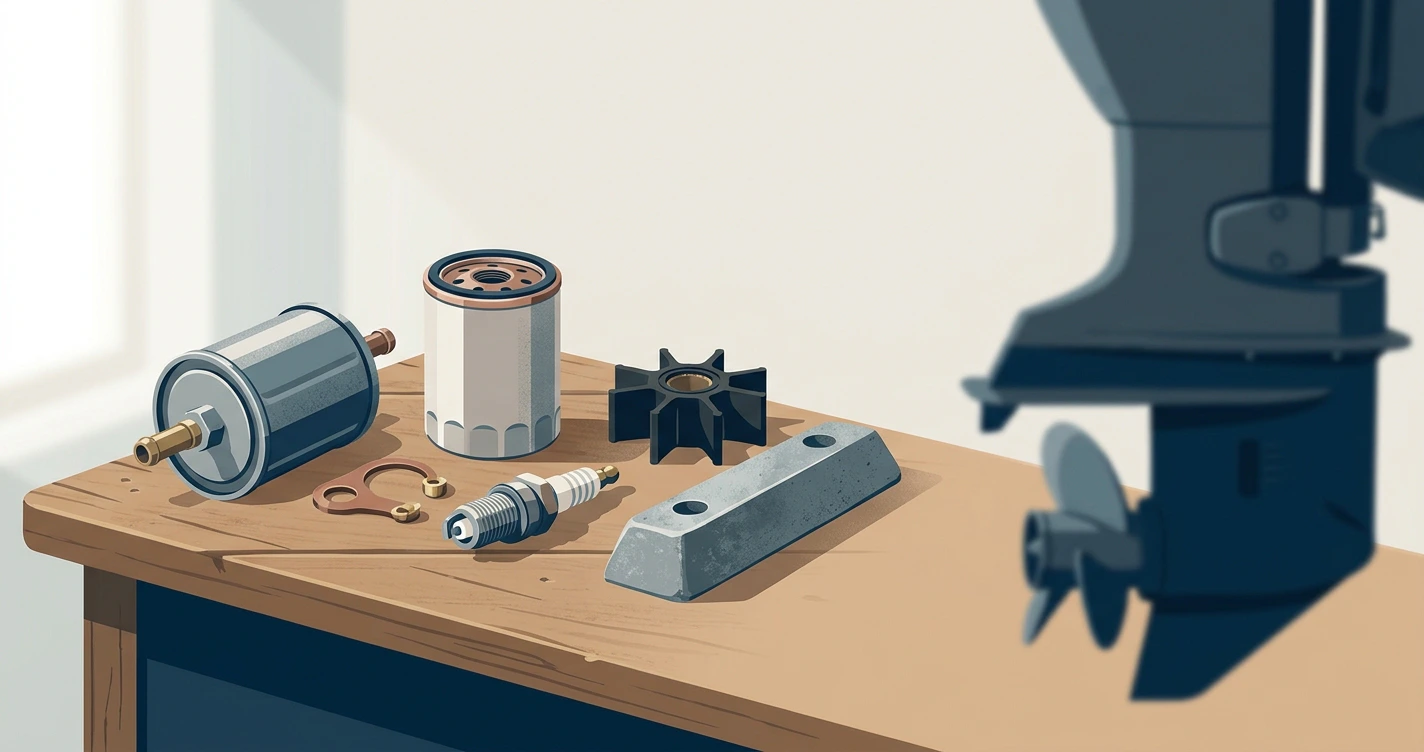
The outboard motor parts and accessories that actually matter are the plain, unglamorous wear items: fuel and oil filters, spark plugs, water pump impellers, and sacrificial anodes. Get those right on the correct schedule and your engine will start every time, run cool, and last for years, no gadget wall required.
There is a whole ocean of marine gear out there, and plenty of it is nice to have rather than need to have. This guide sorts the essentials from the extras so you can spend where it counts, avoid wrong-fit parts, and keep your warranty intact. Whether you run a Yamaha, Mercury, Suzuki, Honda, or Tohatsu, the same core principles apply.
Genuine OEM vs Quality Aftermarket Parts
Every part on your engine falls into one of two camps: genuine OEM (original equipment manufacturer) or aftermarket. Knowing when each makes sense saves money without gambling on reliability.
Genuine OEM parts are made to your engine's exact specifications, often by the same manufacturer that built the motor. They are the right call for anything tied to cooling, fuel delivery, ignition timing, or warranty coverage. The tolerances are dialed in, the materials are marine-grade, and there is no guesswork about fit.
Quality aftermarket parts are produced by third-party companies. The good ones meet or exceed the original spec and can be a fair value for non-critical items: trailer hardware, general-purpose lubricants, cosmetic pieces, and some accessories. The catch is variability. A bargain impeller made from the wrong rubber compound can fail early and cook your powerhead, which erases any savings.
A simple rule works well here:
| Part type | Best choice | Why |
|---|---|---|
| Water pump impeller | Genuine OEM | Cooling failure is catastrophic and fast |
| Fuel filter / water separator | Genuine OEM | Protects injectors and fuel system |
| Spark plugs | OEM-specified | Heat range and gap are engine-specific |
| Sacrificial anodes | OEM alloy | Alloy must match your water type |
| Trailer parts, general lube | Quality aftermarket | Non-critical, well-standardized |
When you are unsure, default to OEM for anything that touches the cooling system, fuel system, or ignition. Those three systems cause the most expensive failures.
Must-Have Maintenance Parts
These are the parts you will replace on a regular schedule. Most outboard manufacturers point to a basic service roughly every 100 hours of use or once a year, whichever comes first, per marine industry guidance from Discover Boating. Here is what that service typically involves.
Filters
- Fuel filter / water-separating filter. This traps water and debris before they reach your injectors or carburetor. On a four-stroke, plan to change it at every annual service. Water in the fuel is one of the most common causes of rough running and no-starts.
- Oil filter. On four-stroke outboards, the oil filter comes out with every oil change. Using the correct filter keeps oil pressure and flow within spec.
Spark Plugs
Spark plugs control ignition, and outboards are picky about heat range and gap. Always use the exact plug your manual specifies. Inspect them at each service and replace on the recommended interval. Fouled or worn plugs cause hard starting, misfires, and poor fuel economy.
Water Pump Impeller
The impeller is a small rubber part that pumps cooling water through your engine. When it fails, your motor overheats quickly, and that can mean serious damage. Mercury Marine and other builders generally recommend replacing the impeller every few hundred hours or every two to three years, and sooner if you run in silty or saltwater conditions. Because inspecting it requires most of the same labor as replacing it, many technicians simply replace it on a set schedule. If you want to understand how heat problems get diagnosed, our guide on marine engine diagnostics walks through how pros trace the real cause.
Sacrificial Anodes
Anodes are blocks of soft metal bolted to your engine that corrode on purpose so your expensive aluminum and steel parts do not. This is galvanic corrosion protection, and it is essential in saltwater. Per the American Boat and Yacht Council E-2 standard, anodes should be replaced once they are about half consumed, and the surfaces must keep clean metal-to-metal contact to work. You can read more about corrosion protection standards from the ABYC. Two quick notes:
- Anode alloy depends on your water. Zinc for saltwater, aluminum for a mix or brackish water, and magnesium for freshwater.
- Never paint over an anode. Paint blocks it from doing its job.
Accessories That Upgrade Your Boating Experience
Once the maintenance basics are covered, a few accessories genuinely improve life on the water. These are worth considering rather than mandatory.
- The right propeller. Prop choice affects speed, fuel economy, hole shot, and engine longevity. It is one of the most impactful upgrades you can make.
- Fuel-water separator with a clear bowl. An in-line separator adds a second line of defense against contaminated fuel, and a clear bowl lets you spot water at a glance.
- Digital gauges or engine displays. Modern gauges show RPM, temperature, fuel flow, and fault codes so you can catch trouble early.
- Flushing kit or muffs. Freshwater flushing after every saltwater trip is one of the cheapest ways to extend engine life.
- A quality battery and marine-grade connectors. Reliable starting and clean power connections prevent a lot of dock-day headaches.
- Cover and support gear. A proper motor cover, spare prop, prop wrench, and a basic spares kit belong in every boat.
Of these, the propeller is where most owners see the biggest difference. Pitch and diameter change how your whole rig behaves, so it is worth matching carefully to your boat and how you use it.
How to Find the Right Part for Your Make and Model
The fastest way to end up with a wrong part is to guess. Outboards change specs between model years, and two engines with the same horsepower can use different impellers, plugs, or anodes.
Use this order every time:
- Find your engine's identification. You need the brand, model, model year, and serial number. The serial number is on a plate or sticker on the transom bracket, and it is the most reliable identifier.
- Match the part to the serial number, not just the horsepower. Horsepower alone is not enough. The serial number pins down the exact production variant.
- Cross-check the part number. Most parts carry a manufacturer part number. Confirm it against your engine before you buy.
- When in doubt, ask a factory-trained technician. A five-minute lookup beats a returned part or a cooling failure.
At Aquamrine Outboard, our parts team matches components to your serial number across every brand we carry, so you get the correct filter, impeller, or anode the first time. If you would rather have the work done, our service department handles the whole job start to finish.
Why Correct Parts Protect Your Warranty
A factory warranty comes with strings, and the biggest one is maintenance. Manufacturers expect you to follow the service schedule and use approved parts and fluids. If a bargain part fails and takes your powerhead with it, that claim gets a lot harder to win.
Protecting your coverage comes down to a few habits:
- Follow the recommended service intervals for your engine.
- Use OEM or manufacturer-approved parts, especially for fuel, cooling, and ignition.
- Keep records. Save receipts and log the hours and dates of each service.
None of this is complicated, and it pays off twice: your engine stays healthy, and your warranty stays valid if you ever need it.
Shop the Outboard Motor Parts and Accessories You Need
The short version is that a small handful of correct parts, changed on time, do most of the work of keeping an outboard reliable. Start by finding your engine's serial number and checking which service interval you are due for, then order the exact filters, plugs, impeller, and anodes it calls for.
If you want a hand matching parts to your motor or would like us to handle the service, request a parts quote or book a service appointment with Aquamrine Outboard. Our team will make sure you get the right pieces and get back on the water ready to go.
Shop Aquamarine Outboard
All outboard motors for sale · Book a service · Parts & accessories
Related guides
Frequently asked questions
What outboard motor parts wear out the fastest?
Fuel filters, oil filters, spark plugs, and the water pump impeller wear out first. Sacrificial anodes also erode over time and need routine replacement.
Are aftermarket outboard parts safe to use?
Quality aftermarket parts can be fine for non-critical items when they meet or exceed the original specification. For cooling, fuel, and warranty-covered components, genuine OEM parts are the safer choice.
How do I find the right part for my outboard?
Use your engine's make, model, year, and serial number to look up the correct part. The serial number is the most reliable way to avoid a wrong-fit component.
Does using aftermarket parts void my outboard warranty?
Using a part that fails and damages your engine can jeopardize a warranty claim. Following the maintenance schedule with correct parts and keeping records is the safest approach.
Author

The Aquamarine Outboard team sells, installs and services Yamaha, Mercury, Honda and Suzuki outboard motors from our San Francisco dealership at 1428 Wallace Ave, helping Bay Area boaters choose, finance and maintain the right engine.