
29
Sep
Outboard Motor Loans: How to Finance Your Next Engine
Key takeaways
- Outboard motor loans spread the cost of a new or repowered engine over several years, freeing up cash while you get on the water sooner.
- Marine loan terms commonly run from 12 months up to 15 years, with rates that track your credit score, loan amount, and whether the engine is new or used.
- Consumer loans suit individual boaters, while fleet and business financing handles multiple engines and offers tax and cash-flow advantages for commercial operators.
- Gather income proof, ID, the engine quote, and boat details before you apply to speed up approval.
- First-time buyers should get pre-qualified first so they shop with a firm budget and avoid surprises at signing.
An outboard motor loan lets you spread the cost of a new or repowered engine over months or years instead of paying the full price up front. You keep more cash in your pocket, get on the water sooner, and match the payment to your budget. This guide walks through how these loans work, what terms and rates to expect, the paperwork you will need, and how consumer financing differs from fleet and business options.
Buying an outboard is a real investment, and you are far from alone in making it. More than 47 million Americans over the age of 6 spent time on a motorboat in 2021, according to a U.S. Fish and Wildlife Service report. Financing is one of the most common ways boaters make that dream affordable.
Outboard Motor Loans vs Paying Cash: The Tradeoffs
Paying cash is simple. You own the engine outright, there is no interest to worry about, and there are no monthly payments hanging over you. If you have the money set aside and the purchase will not drain your emergency fund, cash keeps things clean.
Financing an outboard motor changes the math in a few useful ways:
- You preserve cash. Repairs, dockage, fuel, and insurance all cost money. Keeping savings liquid means an unexpected bill will not sink your season.
- You can buy the right engine now. Stretching a payment over time often means you can afford the horsepower you actually need rather than settling for less.
- You build a payment history. On-time loan payments can help your credit profile over time.
The tradeoff is interest. A loan costs more than the sticker price once you add finance charges, and a longer term means more total interest even at the same rate. The right call depends on your savings, the rate you qualify for, and how much flexibility you want to keep. Many boaters split the difference by putting some money down and financing the rest.
Typical Loan Terms, Rates, and Down Payments
Marine loans look a lot like auto loans, with a few wrinkles unique to boats and engines.
Loan terms. Repayment periods commonly run from 12 months on the short end to as long as 15 years for larger amounts. A shorter term means higher monthly payments but less interest overall. A longer term lowers the monthly bite but costs more across the life of the loan.
Interest rates. Your rate depends mostly on your credit score, the loan amount, and whether the engine is new or used. Rates on new marine engines from major lenders currently start in the high single digits for well-qualified buyers, with used engines carrying slightly higher rates. Your actual offer will move up or down from there based on your credit.
Down payments. Some lenders advertise zero-down financing for qualified buyers, but a down payment of 10 to 20 percent usually earns you a better rate and a smaller monthly payment. It also reduces the risk of owing more than the engine is worth partway through the term.
Here is a simplified look at how term length affects a hypothetical $15,000 outboard loan. These figures are illustrative, not a quote.
| Term | Relative monthly payment | Relative total interest |
|---|---|---|
| 36 months | Highest | Lowest |
| 60 months | Moderate | Moderate |
| 84 months | Lower | Higher |
| 120+ months | Lowest | Highest |
If you are replacing an aging engine rather than buying your first, our guide to repower financing covers how to fold an upgrade into a single manageable payment.
Documents You'll Need to Apply
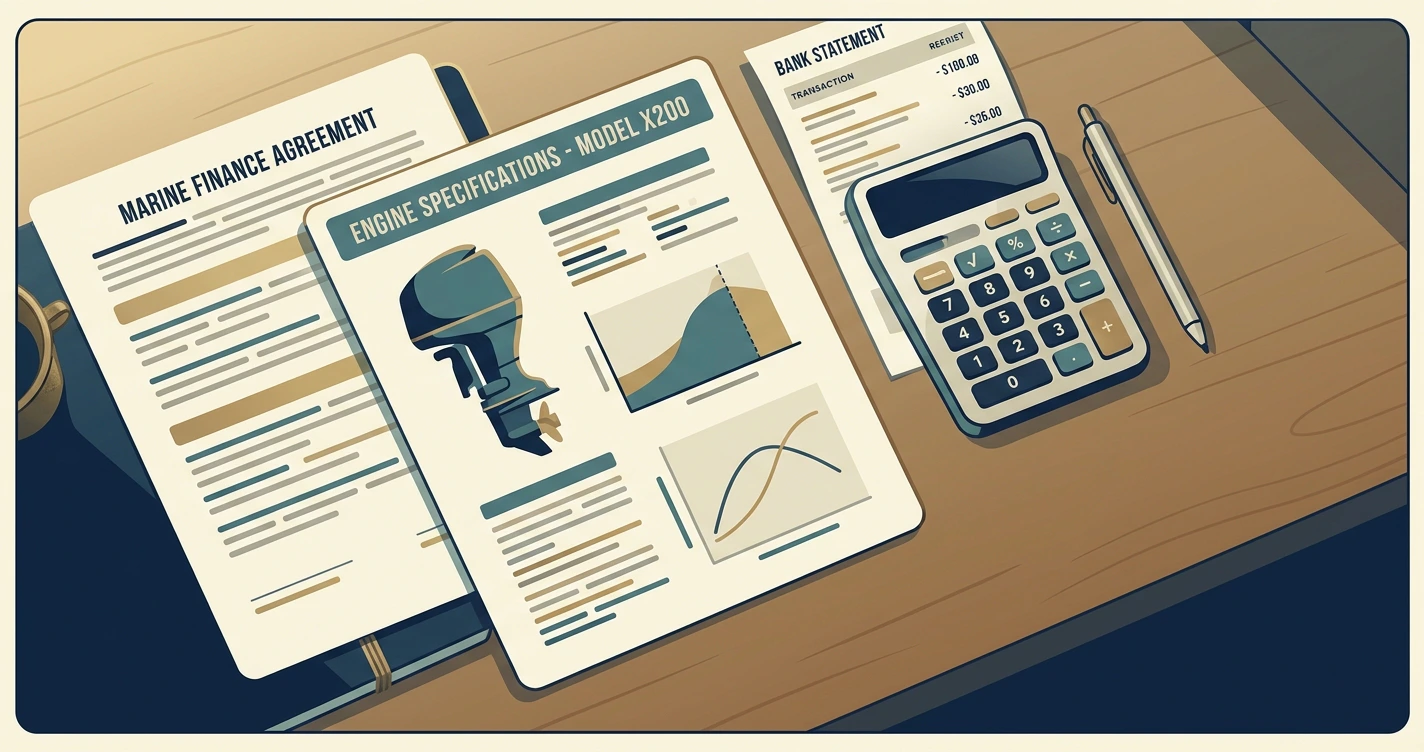
Getting your paperwork together before you apply makes approval faster and less stressful. Most lenders ask for some combination of:
- Proof of identity. A valid driver's license or other government-issued ID.
- Proof of income. Recent pay stubs, W-2s, or tax returns if you are self-employed.
- The engine quote or sales agreement. This shows the amount you want to finance.
- Boat details. The make, model, year, and hull identification number of the boat the engine will power.
- Bank information. For verifying assets and setting up payments.
Having these ready means you can often get a decision the same day. It also helps you compare offers side by side, since lenders can quote firm numbers once they see the full picture.
Consumer Loans vs Fleet and Business Financing
Not every boater is financing a single engine for weekend fishing. The right product depends on who you are and what you are buying.
Consumer loans are designed for individual boat owners. They are usually secured by the engine or boat, come with fixed monthly payments, and are underwritten based on your personal credit and income. This is the path most recreational buyers take.
Fleet and business financing serves charter operators, tour companies, commercial anglers, and anyone running multiple boats. These arrangements can cover several engines at once, factor in business cash flow, and may offer tax advantages such as depreciation on equipment. Terms are structured around a company's revenue cycle rather than a personal paycheck, and lenders often look at business financials, time in operation, and fleet history.
The recreational marine market is large enough to support both. The National Marine Manufacturers Association reported that total recreational boating industry spending reached $55.6 billion in 2024, per NMMA industry data. That scale is part of why lenders offer specialized marine products rather than lumping engines in with generic loans.
If you operate a fleet, talk to a dealer that handles business financing directly so the loan is structured around how your operation actually earns.
Tips for First-Time Boat Buyers Navigating Loans
Financing your first outboard can feel intimidating, but a few habits make it straightforward.
- Get pre-qualified first. A soft pre-qualification tells you your likely rate and budget without dinging your credit. Shop with that number in hand.
- Know your true budget. Factor in insurance, registration, fuel, storage, and routine service, not just the monthly payment.
- Compare the total cost, not just the payment. A low monthly figure over a long term can quietly cost you thousands more in interest.
- Check the engine before you finance it. If you are buying used, confirm the condition of the motor before you sign, so the loan matches what you are actually getting.
- Ask about zero-down and seasonal payment options. Some lenders and dealers offer flexible structures that fit a boating season.
- Read the fine print. Watch for prepayment penalties, and confirm whether the rate is fixed or variable.
A little preparation keeps the loan from becoming the stressful part of getting on the water. At Aquamarine Outboard, our team walks first-time buyers through pre-qualification and matches the engine, the budget, and the loan term so nothing gets lost in translation.
Ready to Finance Your Next Outboard?
Financing turns a big one-time expense into a predictable monthly payment, whether you are buying your first motor or repowering a boat you love. The best next step is to get pre-qualified so you know your rate and budget before you shop.
Aquamarine Outboard offers new, used, and certified pre-owned outboards from Yamaha, Mercury, Suzuki, Honda, and Tohatsu, plus consumer and business financing to match. Request a quote, explore your financing options, or call the shop, and we will get you bought, fitted, and delivered, ready to go on the water.
Shop Aquamarine Outboard
All outboard motors for sale · Outboard motor loans · Pre-qualify online
Related guides
Frequently asked questions
What credit score do I need for an outboard motor loan?
Most lenders look for a mid-600s score or higher for the best rates, though options exist for lower scores at higher interest. A larger down payment can help offset a thinner credit file.
How long can I finance an outboard motor?
Terms commonly range from 12 months to as long as 15 years. Longer terms lower your monthly payment but increase the total interest you pay over the life of the loan.
Can I finance a used or certified pre-owned outboard?
Yes. Many lenders finance used and certified pre-owned engines, though rates are often slightly higher and maximum terms may be shorter than for new motors.
Do I need a down payment for an outboard motor loan?
Not always. Some lenders offer zero-down financing for qualified buyers, but putting 10 to 20 percent down usually lowers your rate and monthly payment.
Author

The Aquamarine Outboard team sells, installs and services Yamaha, Mercury, Honda and Suzuki outboard motors from our San Francisco dealership at 1428 Wallace Ave, helping Bay Area boaters choose, finance and maintain the right engine.