
1
Oct
Outboard Motors for Sale: New, Used & Certified
Key takeaways
- New outboard motors carry full factory warranties; used models cost less upfront; certified pre-owned sits in the middle with an inspection and limited coverage.
- Match your choice to how you boat: horsepower, hull rating, and how many hours you log each season matter more than brand loyalty.
- Financing and a trade-in can shrink your out-of-pocket cost; many buyers roll the value of their old engine straight into the new one.
- Pre-owned boats made up 78.3% of 2024 U.S. boat transactions, so buying used or certified is the mainstream choice, not the exception.
- After purchase, professional rigging and delivery mean your motor arrives mounted, tuned, and water-tested instead of sitting in a crate.
If you are shopping for outboard motors for sale, the fastest way to spend your money well is to decide between three lanes first: new, used, or certified pre-owned. Each one fits a different budget and a different tolerance for risk, and knowing where you land saves you from overpaying for coverage you do not need or underpaying for a motor that leaves you stranded.
This guide walks through all three categories, how to match them to your boating, which brands and horsepower ranges you will see in stock, and how financing, trade-ins, rigging, and delivery actually work once you are ready to buy.
Outboard Motors for Sale: New, Used, and Certified Pre-Owned
Every outboard on the market falls into one of three buckets. Here is what separates them.
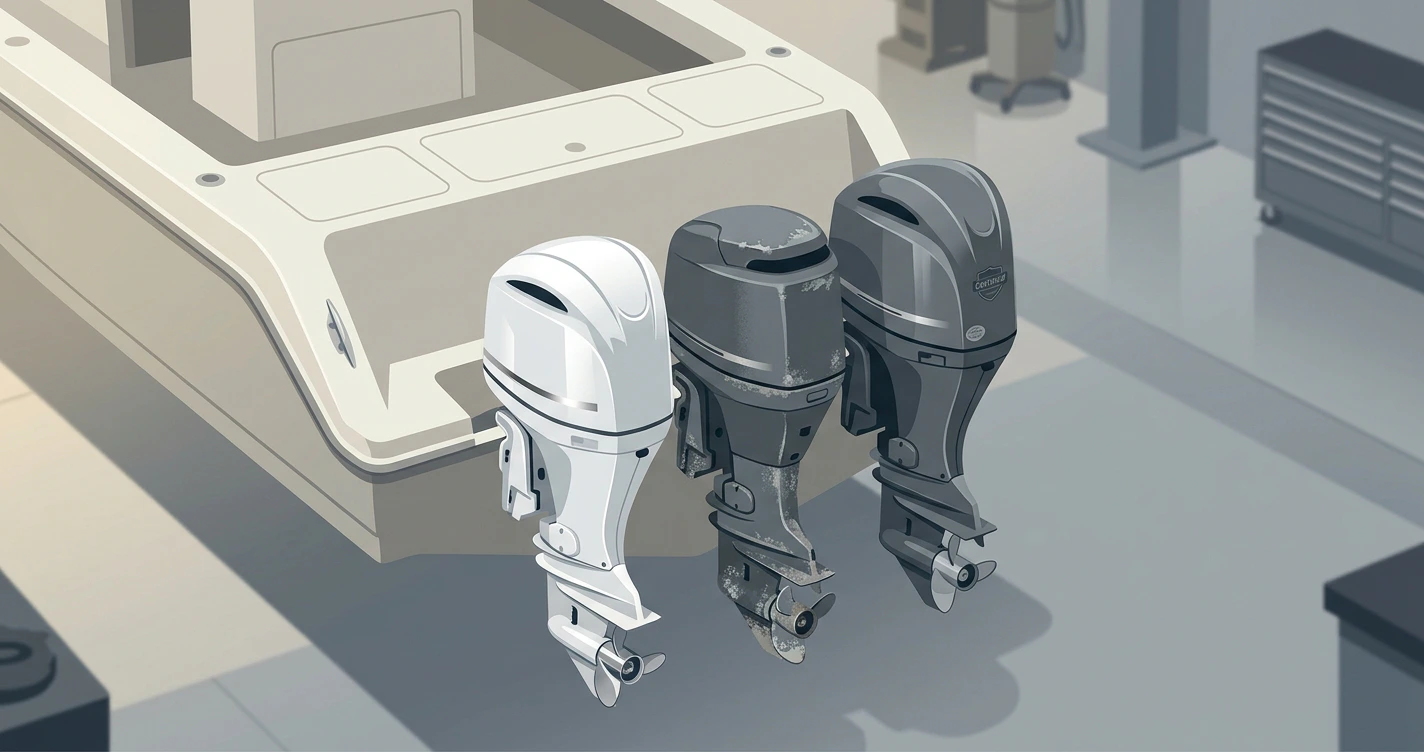
New outboard motors
A new motor has zero hours, the latest fuel-efficiency and emissions tech, and a full factory warranty behind it. You pick the exact horsepower, shaft length, and color, and you never wonder how the previous owner treated it. The trade-off is price: a new four-stroke is the most expensive way into a given horsepower class.
New makes the most sense when you plan to keep the boat for years, you run offshore where reliability is safety-critical, or the warranty itself is part of your peace of mind.
Used outboard motors
A used outboard is the lowest sticker price for a given horsepower. Buy smart and a clean, low-hour engine from a careful owner will serve you for seasons. Buy carelessly and you inherit someone else's neglect.
The catch is verification. Hours, compression, corrosion, and service history all matter, and a private-party seller rarely hands you proof. Before you pay, it pays to know exactly what to inspect. Our guide to buying used outboard motors covers the specific checks that separate a bargain from a headache.
Certified pre-owned outboard motors
Certified pre-owned sits between the two. A certified engine has passed a multi-point inspection, had its service history verified, and usually carries limited warranty coverage. You pay more than a raw used motor but less than new, and you skip most of the uncertainty.
For a lot of boaters this is the sweet spot: real savings without gambling on an unknown engine.
| Category | Upfront cost | Warranty | Risk level | Best for |
|---|---|---|---|---|
| New | Highest | Full factory | Lowest | Long-term owners, offshore use |
| Certified pre-owned | Middle | Limited, verified | Low | Value buyers who want peace of mind |
| Used | Lowest | Usually none | Varies | Confident buyers, inspected engines |
How to Decide Which Category Fits You
Picking a lane comes down to three honest questions.
- How long will you keep the boat? Keeping it five-plus years tilts toward new or certified so warranty coverage spans the hours you will put on it. A short-term boat tilts toward used.
- How many hours do you log a season? Heavy offshore and fishing use rewards the reliability of new or low-hour certified engines. Occasional lake outings make a solid used motor easy to justify.
- What is your real out-the-door budget? Not just the engine, but rigging, a matched propeller, and controls. Financing changes this math, which we cover below.
There is also the question of who you buy from. An authorized dealer gives you genuine parts, factory-trained service, and legitimate warranty support that a casual seller cannot, which matters more than a slightly lower price from a stranger online.
One useful bit of context: pre-owned boats made up 858,798 of U.S. boat sales in 2024, or 78.3% of all transactions, with new boats at the remaining 21.7%, according to NMMA data reported by Marine Industry News. Buying used or certified is the mainstream path, not a compromise.
Popular Brands and Horsepower Ranges in Stock
At Aquamarine Outboard we carry new, used, and certified pre-owned motors from the brands boaters ask for most: Yamaha, Mercury, Suzuki, Honda, Tohatsu, Evinrude, and Nissan. Each has strengths worth knowing before you choose.
- Yamaha is the dependable all-rounder, strong across portable kickers to big V6 and V8 offshore power.
- Mercury spans the widest lineup, from small tiller engines to high-output V8s built for speed and heavy boats.
- Suzuki earns its reputation for fuel efficiency and value in the mid-range.
- Honda four-strokes are known for quiet, clean running.
- Tohatsu punches well above its size in the small-engine class, a great match for tenders and dinghies.
Horsepower ranges you will see in stock:
- 2.5 to 25 hp (portable): dinghies, inflatables, small tenders, trolling.
- 30 to 115 hp (mid-range): aluminum fishing boats, pontoons, small runabouts.
- 150 to 300+ hp (V6 and V8): offshore center consoles, bay boats, and anything that needs to get on plane fast and stay there.
The right choice starts with your boat's capacity plate. Never exceed the maximum horsepower rating stamped there. If you fish offshore, lean toward the higher end of what your hull allows so you have the reserve power for rough water and a full load.
Financing and Trade-In Options That Lower the Price
The sticker is rarely what you actually pay. Two levers bring it down.
Financing spreads the cost into monthly payments instead of one large check, which often lets you step up to a newer or higher-horsepower engine than a cash budget allows. We offer both consumer and business financing, and you can get pre-qualified before you shop so you know your real number. Our overview of outboard motor financing options walks through how to structure a loan that fits your season, not just your signing day.
Trade-ins turn your current engine into instant down-payment value. Instead of selling privately and waiting, you apply the appraised value straight to your new purchase and finance only the difference. For repowers especially, this is how a lot of upgrades happen without sticker shock.
Combine the two and the math gets friendly fast: a trade-in shrinks the balance, and financing turns that balance into a payment you plan around.
How Delivery and Rigging Work After You Buy
Buying the motor is step one. Rigging is what gets you on the water.
Rigging means physically mounting the engine on your transom, connecting the throttle, shift, and steering controls, hooking up fuel and electrical, and matching the right propeller to your boat and how you use it. Prop choice alone changes your acceleration, top speed, and fuel economy, so it is not a detail to skip.
Here is the typical flow after you say yes:
- Appraisal and paperwork, including any trade-in and financing.
- Rigging, where our factory-trained technicians mount and wire the motor and fit a matched propeller.
- Water test, so the engine is tuned and proven before it reaches you.
- Delivery or pickup, with the motor ready to run, not sitting in a crate for you to figure out.
That last point is the difference between an online crate motor and a dealer purchase. We get you bought, fitted, and delivered, ready to go on the water, with the propeller matched to your boat and verified before you ever leave the dock.
Ready to Shop?
The best next step is simple: decide your lane (new, certified, or used), know your boat's horsepower rating, and get pre-qualified so your budget is real before you fall for a motor. From there, browse our outboard motors for sale, and reach out for a quote or to book rigging. Our San Francisco shop can walk you through inventory, financing, and trade-in value in one conversation, so you spend less time comparing and more time on the water.
Shop Aquamarine Outboard
All outboard motors for sale · Financing options · Request a quote
Related guides
Frequently asked questions
Is a certified pre-owned outboard worth the extra cost over a plain used motor?
Usually yes. A certified pre-owned outboard includes a multi-point inspection, verified service history, and limited warranty coverage, which removes most of the guesswork that comes with a private-party used sale.
How much horsepower do I actually need?
Start with your boat's maximum horsepower rating on the capacity plate, then pick an engine at or near that number for the best performance. Fishing offshore favors higher-horsepower V6 or V8 motors; small lakes and tenders do fine with portable 2.5 to 25 hp engines.
Can I finance an outboard motor and trade in my old one at the same time?
Yes. Most dealers apply your trade-in value as a down payment and finance the remaining balance, which lowers both your out-of-pocket cost and your monthly payment.
What happens after I buy an outboard online or in person?
A dealer rigs the motor to your boat, which means mounting it, connecting controls and fuel, matching the right propeller, and water-testing before delivery or pickup.
Are new outboards really that much more reliable than used ones?
New motors have zero hours and full factory warranties, so they carry the least risk. A well-maintained used or certified engine can be just as dependable at a lower price, especially when a technician verifies its condition first.
Author

The Aquamarine Outboard team sells, installs and services Yamaha, Mercury, Honda and Suzuki outboard motors from our San Francisco dealership at 1428 Wallace Ave, helping Bay Area boaters choose, finance and maintain the right engine.